29 October 2011

Defining Research, Part One


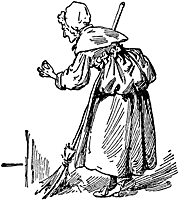
"Oh, it's my ancestry back to Eve!"
Recently, James Tanner over at Genealogy's Star discussed what he meant when he used the word "research." Now, I appreciate these sort of symantics-driven posts, because, as in most arenas of life, it is always important to define your terms before you begin any sort of discussion. And, as genealogy is full of the necessity of discussion (be it on blogs, on mailing lists, or via email), defining the word "research" certainly is key.

Why? I'd like to proffer an example of a recent exchange I had with a researcher who contacted me regarding information I have on an Ancestry tree. In this instance, note carefully the use of the word "research" by the person who wrote to me:

In this case, a woman wrote to me to notify me that some of my dates and locations for a man in my family tree were wrong. I had been researching this man for a little over five years, concentrating in this time on his life in the United States after his immigration. This woman speculated that my information was inaccurate, due to what her "research" had revealed.

Her "research," as it turned out, consisted of a naturalization index card she had found on Ancestry, as well as family information she had found on various family trees online (all of which, I would note, are iterations of my own research into this hitherto un-digitized family).

My information was faulty, she said, because unlike my family tree information which said that this man had arrived in the United States from his birthplace of Milan in 1839, the naturalization index card that she had found on Ancestry showed that he had arrived in 1848 and was from Austria. My dates, she said, seemed "wrong."

Now, in this case, the extent of "research" that had led this woman to seek to clarify/correct my own research was, it seemed, a piece of indexed information that she had found on Ancestry. I was happy to send along a scan of the gentleman's entire naturalization file which I had received from the East Baton Rouge Clerk of Court's office. The file showed that the man in question had, indeed, arrived in 1839, although his declaration of intent was filed in 1848--this date was used on the naturalization card as the man's date of arrival in the United States.

I was also happy to point out to this researcher that the naturalization card was somewhat misleading in suggesting that the man was from Austria; in fact, as per the naturalization file, when he became a US citizen, he swore to revoke any and all allegiance to The Emperor of Austria, who, at the time of the man's naturalization in 1854, ruled over Milan as part of the Austrian empire.

Now, I concede that the naturalization card was somewhat misleading (and a good lesson as to how indexes can lead us to reach improper conclusions in our research). I also applaud her natural tendency to question the information she saw in my tree (I do, I'm sure, have some mistakes in there), but I also question this person's quickness to "correct" without having performed a modicum of true research on her own.

The key word here is "research." To my mind, calling this woman's work "research" is an abuse of the word, if only because what she had done was only half of the process deserving of that word. "Performing a search," "taking an overview of available information," or even "surveying previous research" is, of course, part of the research process. But locating an online family tree and preparing to undermine that research based on research that hasn't even been performed seems overeager at best, a slippery slope toward shoddy research at worst.

I'm happy (sarcastically) to report that the 15-page Genealogy Report regarding this matter that I sent this researcher has now been faithfully transcribed by her into her family tree, without attribution or documentation as to where she obtained the initial research. Of course, seeing as how I emailed her five years worth of research (along with scans) intending to bring her up to speed, and she never took the time to write and thank me for taking time to do so.... well, the move to proudly display my work as her own doesn't surprise me much.

It is, apparently, all part of her diligent "research."

28 October 2011

Blogger Headaches: Stat Spam

If you have a Blogger blog and enjoy checking your site stats, you may be seeing a bunch of links popping up from random sites that don't seem (on the face) likely places that would be linking to a genealogy blog.

I won't humor the idiots foisting fake stats on our blogs by naming them, but if you check your Blogger stats, you're likely to see one or two listed. One I get constantly is a goth site, another is an auto injury attorney's site. All of them, in my opinion, suck.

Anyways, just thought I would give a heads-up to fellow bloggers who may make the mistake of clicking on these false referrers, thereby giving the b*tards the view traffic they so sickly crave.

If you totally don't know what I'm talking about, there's a nice post from a Blogger help guru here. For those who do know what I'm talking about, the post is still an interesting and informative one, when it comes to the web's greasy underbelly.

26 October 2011

Beautiful Books: An Enduring Tribute

One of the most genealogically-interesting (if not also beautiful) donation/collection tags I have seen:

.

Found in: An Outline History of Orange County (1846).

25 October 2011

Tribune Tuesdays: Hungry Dog

From: The Oakland Tribune, 22 October 1912 HUNGRY DOG ATTACKS FIVE-YEAR-OLD GIRL Attacked by a hungry dog while returning home from a butcher shop this morning, Georgie Santon, a 5-year-old girl living at 2239 Magnolia street, was bitten upon her cheeks several times by the animal. The little girl had been on an errand for her mother. She was taken to the receiving hospital by her parent where the injuries were dressed by steward Platt.

24 October 2011

Got a Good Genea-Mystery?

I was perusing the great Writers & Poets website this morning, when I ran across the following call for submissions:

SMALL PRESS seeking submissions for mystery anthology with genealogy theme. Open to interpretation as long as genealogy is main theme. You never know who’s part of your family! 3,000–4,000 words. Deadline: February 29, 2012. Free book upon publication. Send submissions to M. Dellafera, 94 Wheeler Rd., Hollis, NH 03049. Questions: mdellafera@charter.net or lwatskin@gmail.com.
I figured that I'm not the only genealogy-buff who also loves a good mystery, so all burgeoning writers should sharpen their pencils! The call is for short stories (3-4,000 words).

Maybe a short story called "The Mystery of the Citation-less Death Date"? Or perhaps "The Woman Who Gave Birth to Grandmother"? The possibilities are truly endless!

But seriously... if anyone wants to form a writer's support group let me know!


20 October 2011

Geneablogger Open Thread: The Genealogy Experience

Good ol' Thomas posted an Open Thread for this Thursday in regards to the necessity (and meaning) of the genealogy experience, and as for most other things in this world: I have an opinion!

Firstly, the intangible experience of genealogy, I believe, is vital to the process of discovery that drives all of our research forward. How that experience materializes is, undoubtedly, different for everyone. For me, at first blush it's a Sherlock Holmes-ian desire to root out the truth, discover the details, and see everything correctly in its place.

This part of the experience is exhilarating: there's the thrill of the hunt, running (sometimes in circles) around an ancestor, trying like hell to pin them down, to establish them distinctly. I find a record, or a corroborative link and the first words out of my mouth are "Haha! I've got you!" It's a chase, a pursuit, and the high when I come out on top is unspeakable. This is the part of genealogy I am addicted to.

Then there is the experience that lends itself to more thoughtful research. I call it "coloring inside the lines," and it involves getting the details on people's lives. This is a more-painstaking process, but incredibly gratifying, as the life experiences of the numbers and letters in my database turn into the story of real people, real lives, ensconced in history and reactive to the worlds around them. This is the part of the experience that reminds me that as I live today, so all these people lived... and I feel honored to know more about them. Sometimes I realize that I may be the first person to have thought of these people in decades, if not centuries. That feeling ties me to the people I research, and some of them, strangely, almost become my friends.

That, pared down and simplified, is my own experience of genealogy.

The software, the books, the libraries, the mailing lists and sites... these are all tools, as I see it, and not the central core of genealogy itself. Our mastery of them speaks not to our abilities but to the ways in which they have helped us manifest the true genealogy experience, therefore the tools rank secondary to the process of discovery and experience of genealogy as each of us experience it.

I see it like this: my husband, who is an electrician, is not made an electrician because of the tools he uses. You could never give his tools to an un-trained individual and expect them to perform the sort of complicated and dangerous work he does on a daily basis. The essence of his being an electrician is the extent of his learning, the depth of his experience, and the now-intuitive way that he understands electricity.

And so it is with genealogists.

This may explain why many who are in touch with their own true experience of genealogy balk so much at others who wield the tools and use the words, but seem to have no heart or skin in the game. Maybe we're not so much angry at them for sullying the world with misinformation, or so much peeved with them for their relentlessly fabricated trees as we are sorry for them that they have, in some way, missed the point. The experience of genealogy, the TRUE experience of genealogy, seems to have passed them by. They have the tools, but not the experience, and so seem woefully unprepared for their own research, and seem oblivious to their own family trees.

So yes, I would say that the experience of genealogy is central. Without that core emotional connection to the research, our ways become somewhat blind. We could travel the world and visit every repository, even piece together a remarkable family tree. But without the emotional component of genealogy, all it is is a process, and not an experience.

That, to me, seems somewhat devoid of meaning, and I regret those stuck on process who don't get to experience the subtle changes of perspective and sense of self that comes with the real genealogy experience. I wouldn't be who I am today without such experience, and to have lost the chance by being blind to it would be a sad fate for me, indeed.

18 October 2011

Tribune Tuesdays: Instant Death

From: The Oakland Tribune, 14 October 1912 INSTANT DEATH UNDER FREIGHT TRAIN WHEELS Instant death followed a fall beneath the wheels of a freight train, when A. Nelson, a brakeman for the Oakland and Antioch Railway, lost his balance and fell between two cars. The body was mangled almost beyond recognition. The accident occurred at 10:30 yesterday morning at the junction of the Snake and Moraga roads, in the Piedmont hills. Mason was 33 years of age and unmarried.